Why an HVAC course empowers children of veterans
Children of military veterans often grow up around values like discipline, service, and teamwork. Those same values align naturally with the skilled trades—especially HVAC (heating, ventilation, and air conditioning). An HVAC course for veteran children can turn curiosity into capability, offering a fast, reliable path to a rewarding career that prizes hands-on skill, safety, and problem-solving. With a national shortage of qualified technicians and an expanding focus on energy efficiency, indoor air quality, and electrification, the trade offers strong job stability and mobility. Whether in a hot, humid climate or a cold, snowy region, every community needs well-trained pros who understand comfort systems and deliver quality installation.
Early exposure matters. A thoughtfully designed course introduces core principles in a way that builds confidence: what temperature and heat really mean in practical terms, how pressure and airflow interact, why ducts and filters matter, and how components like compressors, evaporators, and blower motors work together. Clear demonstrations and step-by-step labs teach safe tool use and diagnostic thinking from day one. Students learn to measure static pressure, interpret nameplates, follow wiring diagrams, and apply basic electrical theory in real tasks—skills that translate directly to entry-level roles and apprenticeships.
Relevance keeps momentum strong. Modern homes and businesses increasingly rely on heat pumps for efficient heating and cooling, and today’s high-performance systems demand technicians fluent in airflow, zoning, and system design. A robust course shows how to size equipment responsibly, why duct leaks and poor balancing undermine comfort, and how commissioning ensures long-term reliability. Students explore refrigerant charging techniques that respect environmental rules and learn the fundamentals of gas furnaces, from combustion safety and ventilation to detailed checklists that protect customers and technicians alike. The emphasis stays on quality installation and field-ready habits—tight brazed joints, correct torque specs, accurate electrical measurements, clean condensate management, and documentation that proves the job was done right.
Mindset is a differentiator. Growing up in a veteran household often cultivates resilience and adaptability—traits that help new technicians handle unpredictable service calls, weather extremes, and detailed commissioning tasks. Students discover how to break big problems into small tests, use meters and gauges with intention, and confirm a diagnosis before replacing a part. The result is a powerful combination: character shaped by service and technical competency honed through career-ready HVAC education.
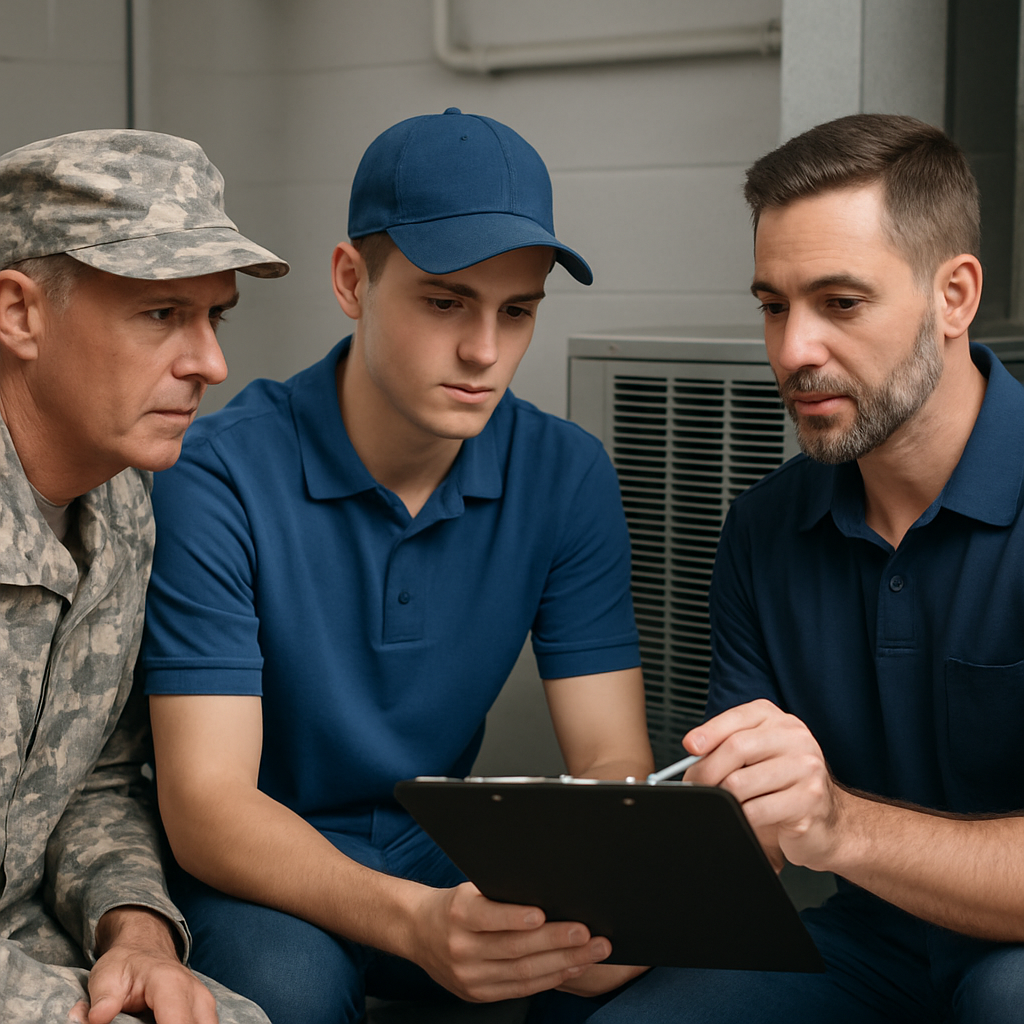
What a high-quality HVAC course for veteran children includes
A great curriculum blends theory, hands-on labs, and real-world scenarios. It starts with safety: lockout/tagout basics, personal protective equipment, ladder use, electrical awareness, and proper handling of refrigerants and combustion appliances. Tool familiarity—multimeters, manometers, vacuum pumps, torches, recovery machines, and micron gauges—follows closely. Students don’t just see the tools; they practice with them, building muscle memory that carries into the field.
Foundational topics come next. Learners see how heat moves by conduction, convection, and radiation; they observe pressure-temperature relationships; and they connect those concepts to everyday decisions like superheat and subcooling targets. By measuring total external static pressure, they grasp why poor duct design hampers performance and why airflow verification is non-negotiable. Lessons in airflow and zoning lay the groundwork for balancing comfort room-by-room, while system design modules explain how equipment sizing and duct geometry work together. Thermostat wiring, control strategies, and sequences of operation are demystified with labeled boards and walk-throughs of real schematics.
Modern equipment deserves modern instruction. With heat pumps on the rise, students learn defrost strategies, reversing valve diagnostics, auxiliary heat integration, and cold-weather optimization. Labs on refrigerant charging emphasize deep-vacuum practices, moisture prevention, leak detection, and compliance with environmental standards. On the heating side, furnace fundamentals cover combustion analysis, draft verification, flame rectification, and ventilation safety—skills critical to protecting occupants and ensuring code-compliant installations. Across every unit, quality control and commissioning are taught as habits, not afterthoughts: verify airflow, confirm charge, check electrical integrity, and document results.
Soft skills elevate technical skill. Students practice clear communication, from explaining a diagnosis to discussing maintenance plans. They build a professional presence: organized work areas, careful tool stewardship, and accurate job notes. Instructors model how to listen to customers, manage expectations, and translate technical issues into everyday language. This makes graduates more employable and better teammates on service and install crews.
Flexible delivery matters for busy families. A veteran-friendly program may combine hands-on classroom learning with online courses to support different schedules. Short learning sprints, weekend labs, or compact summer intensives keep students engaged without overwhelming them. Many programs also offer optional exam prep for credentials like EPA Section 608, opening doors to refrigerant-handling roles right away. To explore formats, modules, and skill pathways, resources like the HVAC course for veteran children provide a helpful starting point for planning the journey from interest to competence.
From exploration to employment: practical pathways and real-world outcomes
Motivation grows when students can envision a future. A strong course translates new skills into a tangible plan: pre-apprenticeship experience, entry-level installer or maintenance roles, and structured growth into service diagnostics, commissioning, and ultimately design leadership. Graduates often start by assisting on installs—setting equipment, brazing linesets under supervision, pulling deep vacuum, measuring static pressure, and verifying thermostat operation—before advancing to seasonal start-ups, airflow corrections, and performance tuning. With consistent practice, they move into troubleshooting duties, reading wiring diagrams end-to-end and methodically isolating faults.
Credentials help. Earning EPA 608 certification validates understanding of safe refrigerant handling; later, students may pursue manufacturer-specific product training or industry credentials to deepen expertise. Portfolios matter too. Keeping a record of labs—photos of properly set manifolds, annotated pressure and temperature logs, before/after airflow readings, commissioning checklists, and neatly wired control panels—provides compelling proof of competence to hiring managers. In interviews, candidates who can explain their diagnostic steps and show documentation stand out.
Case scenarios bring the learning to life. Consider a high school senior from a veteran family who completes an intensive fundamentals track plus weekend labs. By graduation, this student can safely meter voltage, identify common control faults, measure superheat, verify blower performance, and use a micron gauge to confirm proper evacuation. Equipped with a basic toolkit and solid lab hours, they secure a role on an install crew for the summer. As they build confidence—sweating clean joints, sealing ducts, leveling condensing units, and documenting results—they become a go-to teammate. Within months, they’re assisting with heat pump commissioning and helping diagnose airflow imbalances with static pressure measurements. That’s a realistic, repeatable trajectory for motivated learners.
Support networks accelerate progress. Veteran parents and mentors can reinforce safety culture and help with job shadows at reputable shops. Guidance counselors, workforce boards, and community nonprofits may offer entry-level tool stipends, transportation assistance, or scholarship pathways. For students, small habits add up: practice fractions and decimals to speed up calculations, review basic electrical theory regularly, and cultivate careful note-taking. In the shop, arrive early, keep the truck organized, ask clear questions, and treat every call as a chance to learn.
Industry trends are favorable. Electrification and efficiency incentives are driving demand for technicians who truly understand airflow, commissioning, and refrigerant charging on modern equipment. Indoor air quality, ventilation upgrades, and building performance testing are expanding career options beyond traditional service calls. With time, technicians can specialize in controls, building automation, energy auditing, or high-performance system design, or transition into leadership roles—field supervisor, project manager, trainer, or even small business owner. Each step is built on the same foundation: disciplined safety, accurate measurement, and quality installation practices learned in a rigorous, hands-on course.
Most of all, the path stays practical. Learn fundamentals, apply them in labs, document results, and bring that discipline to the field. For children of veterans, the trade rewards the very qualities they’ve seen modeled at home—integrity, teamwork, and perseverance. With the right training and mentorship, an HVAC course for veteran children becomes more than a class; it’s a launchpad to meaningful work, steady income, and a profession that serves the community in every season.

Born in Sapporo and now based in Seattle, Naoko is a former aerospace software tester who pivoted to full-time writing after hiking all 100 famous Japanese mountains. She dissects everything from Kubernetes best practices to minimalist bento design, always sprinkling in a dash of haiku-level clarity. When offline, you’ll find her perfecting latte art or training for her next ultramarathon.