Why AI is Transforming Jewellery Product Photography
Few categories are as visually demanding as jewellery. Metals must gleam without glare, gemstones require true-to-life fire and scintillation, and every millimetre matters on a high-zoom product page. Traditional workflows—booking studios, shipping fragile items, building sets, reshooting for tiny changes—are expensive and slow. AI jewellery product photography replaces this friction with intelligent, scalable visual production that aligns with modern e-commerce timelines and budgets.
AI-driven platforms can turn sketches, CAD files, or quick smartphone references into polished, consistent imagery. That means collections can be visualised before the first prototype is cast, enabling faster merchandising, pre-order campaigns, and earlier marketing momentum. For established brands, catalogue refreshes and seasonal edits happen in days rather than weeks, with style presets guaranteeing on-brand consistency across packshots, on-model lifestyle scenes, and campaign hero images.
Speed is only half the story. Quality has leapt forward, too. Deep learning models trained on jewellery’s unique optics accurately simulate metal microtextures, diamond dispersion, and complex reflections. The result is photorealism that stands up under 4K zoom, supports marketplace requirements, and elevates customer trust. In side-by-side tests, AI-generated packshots frequently outperform traditional photos in PDP engagement, because they are cleaner, lighter, and precisely lit for shoppable clarity.
For artisans, independent designers, and growing luxury labels, AI also unlocks creative freedom. Want to test a rose-gold variant, a different cut, or an alternative setting? Generate variations in minutes, not weeks. Want the same ring worn in natural morning light, then re-shot on a velvet backdrop for a holiday edit? Recreate scenes with identical camera angles and shadows—no reshoots. A London atelier can preview a bridal capsule in multiple styles before committing to casting, while a DTC brand can localise visuals for Paris or Dubai with cultural cues in the set design, all from the same core asset.
Brands exploring AI jewellery product photography gain a sustainable advantage, too: fewer shipments, fewer damaged pieces in transit, and dramatically reduced reshoot waste. The combination of accuracy, speed, and control makes AI not merely an alternative to traditional photography—it’s a production backbone built for omnichannel retail.
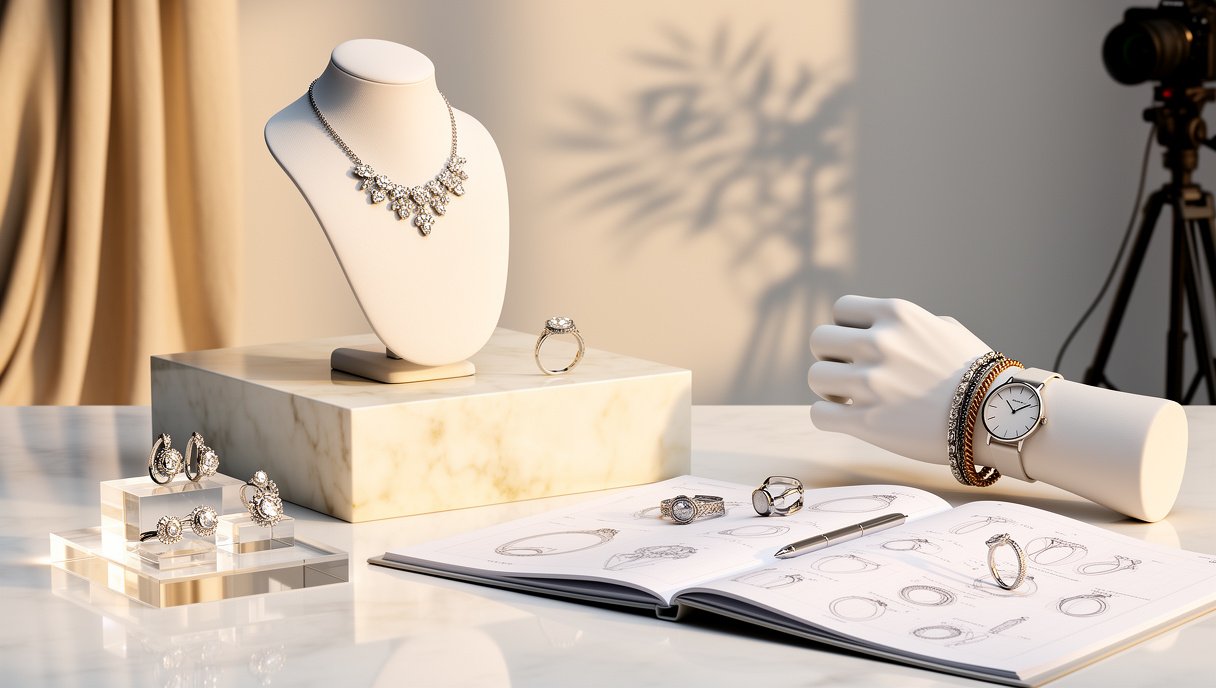
How AI Achieves Photorealism: Metals, Gems, and Micro-Detail
Photographing jewellery is a technical art: reflections are unforgiving, gemstones behave differently under various spectra, and macro lenses reveal every flaw. AI addresses these challenges by modelling light and material behaviour from the ground up. Advanced pipelines translate CAD geometry into highly realistic materials, or infer 3D structure from well-lit product photos. Sophisticated render engines and neural upscalers then refine details to 2K and 4K outputs suitable for zoom-enabled galleries and print.
Metal realism depends on accurate specularity, anisotropy, and micro-surface roughness. AI models learn the subtle differences between polished platinum and brushed gold, maintaining crisp highlights without clipping. Tiny hallmarks and engravings remain legible at macro scale, while intelligent denoising preserves the natural falloff of light. For pave settings, reflections across dozens of stones are coordinated for lifelike sparkle rather than artificial uniformity, delivering the nuanced “pop” customers expect when comparing prongs and pavé density online.
Gemstones demand even more care. Diamonds need controlled dispersion and scintillation under virtual studio or daylight conditions; coloured gems require authentic saturation and undertone without overprocessing. Today’s AI integrates spectral data and HDRI lighting to simulate how stones interact with real-world environments—white backgrounds, velvet trays, or sunlit windows—ensuring true-to-life colour and fire. Calibrated workflows map brand-specified metal colours, gemstone grades, and finish treatments to keep every SKU on-spec across a growing catalogue.
Consistency is a core strength. Cameras move, lights shift, and human fatigue sets in during long shoots; AI engines, by contrast, keep angle, focal length, shadow softness, and depth of field identical across a series. That means packshots align perfectly from thumbnail to PDP, and lifestyle scenes can be rerun with fine-tuned props or new skin tones without sacrificing continuity. For on-model imagery, AI blends realistic hand poses and necklines with controlled reflections on metal surfaces, eliminating the tough retouching cycles that usually follow a long day on set.
Finally, e-commerce readiness is built in. Transparent or pure-white backgrounds, natural shadowing, and precise edge handling satisfy platform rules without losing realism. Image sets can include alternative views—front, three-quarter, macro detail, clasp close-up—rendered from one core configuration. With presets for aspect ratios and compression, assets move directly from studio to PDP, social, and print with minimal manual intervention.
Practical Workflows, Real-World Scenarios, and Results
Implementing AI in jewellery content production starts with source material. If CAD files exist, they offer the fastest route: upload models, assign verified materials, select lighting environments, and generate a family of outputs. If only sketches or sample photos are available, AI can extrapolate geometry and finishes, providing a believable foundation for merchandising while prototypes are in progress. Many teams then create brand presets—metal palettes, stone libraries, camera angles, and backdrop sets—to lock in repeatable styles across campaigns.
Consider three common scenarios. First, a multi-retailer brand preparing a collection launch needs hundreds of SKUs photographed to consistent specs. AI creates a master packshot style (pure white with soft ground shadow), a lifestyle variant (marble slab with natural window light), and an on-model sequence (hands and neckline in neutral tones). Each variant inherits the same angle and focal length, so the site grid looks meticulous and PDPs feel cohesive. Second, an independent designer in Manchester wants to experiment with mixed metals and stone cuts before committing to production. AI generates gold, white gold, and platinum versions of a halo setting plus oval and pear centre stones, enabling a quick A/B test on social. Third, a heritage watch retailer needs macro detail of bezels and dials for print; AI outputs 4K close-ups with razor-sharp indices and anti-reflective glass treatments that read beautifully in brochures.
Operational gains compound quickly. Turnaround times drop from weeks to days, and reshoots become simple parameter changes rather than costly studio returns. Teams can respond to trading data in real time—if a particular angle boosts add-to-cart rate, it becomes the new default across the catalogue. If a marketplace rejects images for background compliance, style rules adjust globally in minutes. Because everything is reproducible, seasonal refreshes and regional merchandising (winter-themed sets, Lunar New Year motifs, beach-side summer scenes) become reusable playbooks rather than one-off shoots.
Quality control is straightforward with structured checklists. Before publishing, validate gemstone hue accuracy against brand swatches, confirm metal sheen under multiple light setups, inspect prongs and micro-pavé at 200% zoom, and verify consistent ring sizing across size charts. Attach SEO-friendly filenames and alt text (“18k yellow gold solitaire diamond ring, 1.0ct”) to strengthen discoverability. Where regulatory or marketplace rules require disclosure, note when images are AI-generated or CAD-derived while emphasizing that materials, carat weights, and measurements are faithfully represented.
Beyond PDPs, AI assets power the full marketing stack. Social carousels, email hero images, and print catalogues originate from the same base scenes, keeping campaigns coherent. For experiential retail, AI-ready 3D can drive 360 spins, virtual try-ons, or AR placements. When a New York DTC brand tested AI-based lifestyle imagery against traditional studio shots, click-through improved and returns dropped—customers saw truer metal tones and more informative macro details before purchase. Over time, the creative library becomes a strategic asset: a searchable, reusable archive of scenes, materials, and angles that scales as the brand grows.
In an industry where millimetres and micro-shadows shape perception, the promise of AI-driven visual production is precision without compromise. Teams gain speed, control, and creative range; customers get cleaner, clearer images that answer buying questions at a glance. The result is a virtuous cycle—higher engagement, stronger conversion, and fewer returns—built on visuals that look exactly as fine jewellery should: exquisite, accurate, and ready to shine anywhere they appear.

Born in Sapporo and now based in Seattle, Naoko is a former aerospace software tester who pivoted to full-time writing after hiking all 100 famous Japanese mountains. She dissects everything from Kubernetes best practices to minimalist bento design, always sprinkling in a dash of haiku-level clarity. When offline, you’ll find her perfecting latte art or training for her next ultramarathon.